

In recent years, potato growing farms in many regions have significantly expanded their storage capacities. This development is driven on the one hand by marketing partners’ expectations to receive potatoes of consistently high quality throughout the year. On the other hand, favorable price developments during the marketing season have made storage economically viable for many producers.
These trends will also be reflected in the technical and exhibition program at PotatoEurope 2026, taking place on 9 and 10 September 2026 for the first time at Rittergut Gestorf 1 in Springe near Hannover, organized by DLG (German Agricultural Society).
© Wulf
Ventilation systems for bulk storage
In building-based storage of industrial and processing potatoes intended for further processing into French fries, chips, starch or convenience products, low storage costs combined with high handling efficiency during loading and unloading are often the main priorities. These requirements can frequently be met more easily with bulk storage than with storage in boxes.
On the other hand, in bulk stores – especially during long-term storage – there is an increased risk of pressure bruising, the intensity and frequency of which can rise significantly due to large stacking heights. As a result, the marketability of the potatoes can be considerably reduced depending, among other factors, on the intended processing route.
© Wulf
The various ventilation systems used in bulk storage differ primarily in the way air is directed by fans for pressure generation and in the duct systems used to distribute this air within the potato pile.
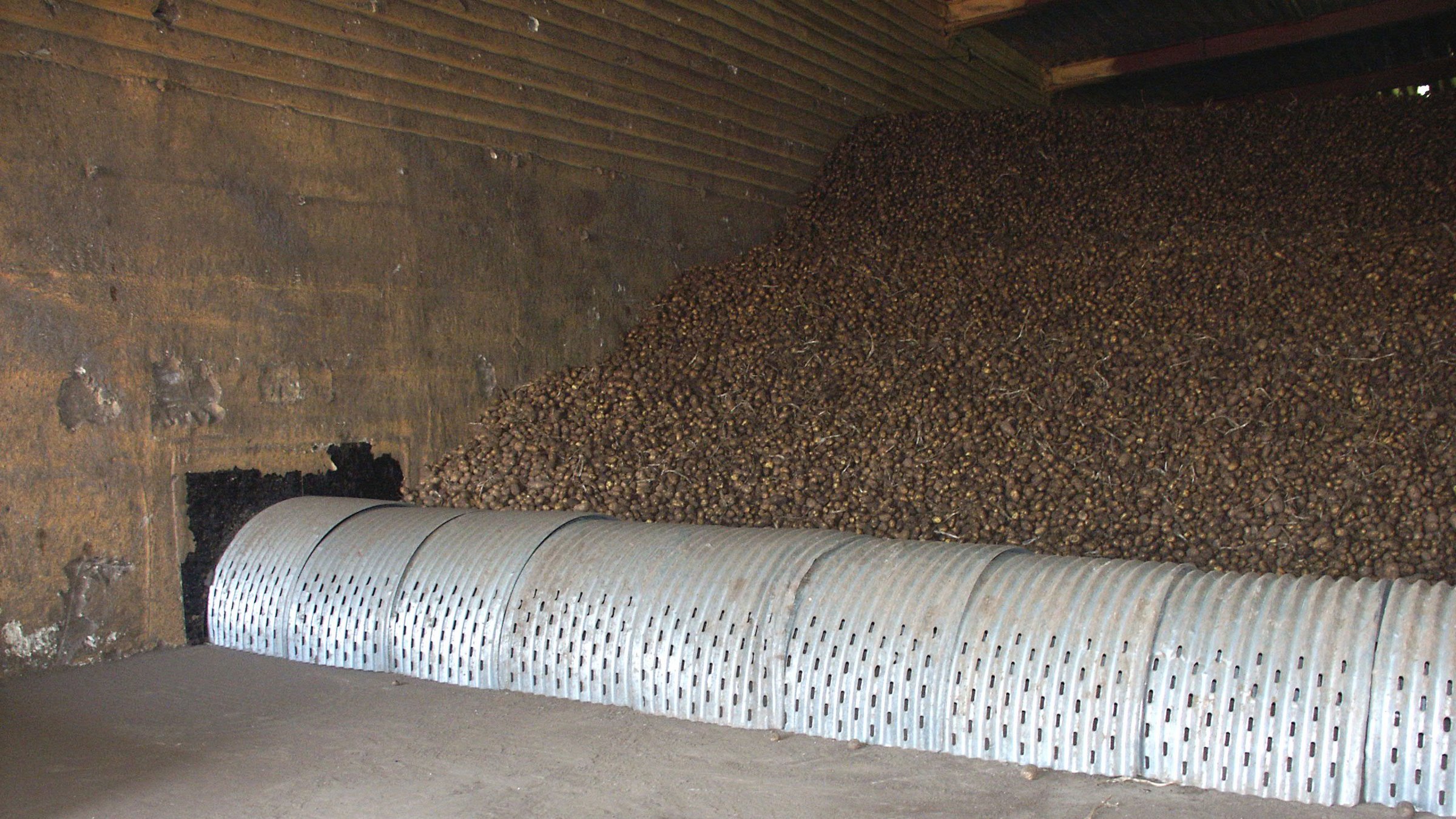
- Above‑floor ducts
Above‑floor ducts are often used when storage facilities need to be constructed as cost‑effectively as possible and/or when the space, after potatoes have been removed, is intended to be used for other purposes, such as temporary grain storage, while complying with food safety regulations. For short‑term storage or the repurposing of older buildings, ventilating bulk stores is also most easily achieved using above‑floor ducts. The ventilation industry offers metal half‑round ducts or wooden triangular ducts for this purpose. - Under‑floor ducts
Equipping bulk stores with under‑floor ducts creates a completely even floor surface, which significantly simplifies loading and unloading compared with above‑floor ducting. Although under‑floor ducts require higher investment costs due to the comparatively greater construction effort, they cause hardly any repair costs and do not reduce the available storage volume. The arrangement of the under‑floor ducts should ideally be perpendicular to the filling direction: this limits duct length and the required cross‑sectional areas, while also facilitating more intensive ventilation of freshly harvested potatoes during intake. - Fully slatted floors
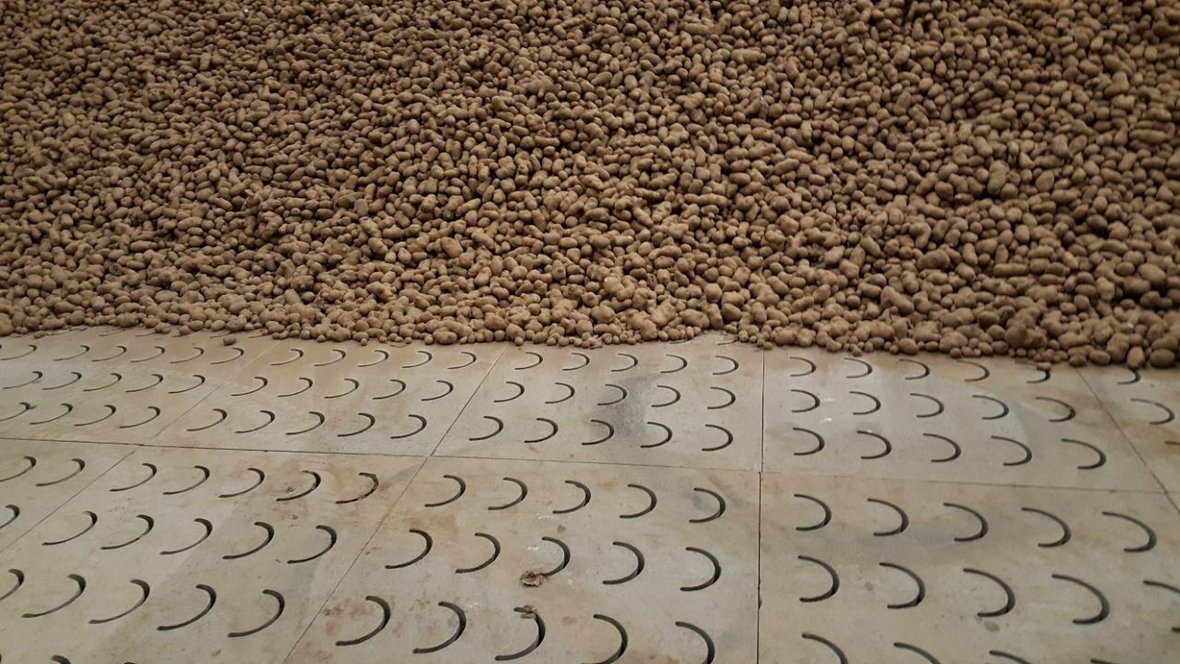
With fully slatted floors, ventilation of the potatoes is carried out through a completely perforated floor surface. Only concrete slatted floors supported by beams are used for this purpose. These slatted floors, specially designed for potato ventilation, are available in lengths of up to 3 meters, allowing for appropriately wide duct sections. Air distribution from the fans to the ducts is always routed through walkable ventilation walls, and individual ducts can be closed using flaps or sliders when needed. - Ventilation Systems for Box Storage
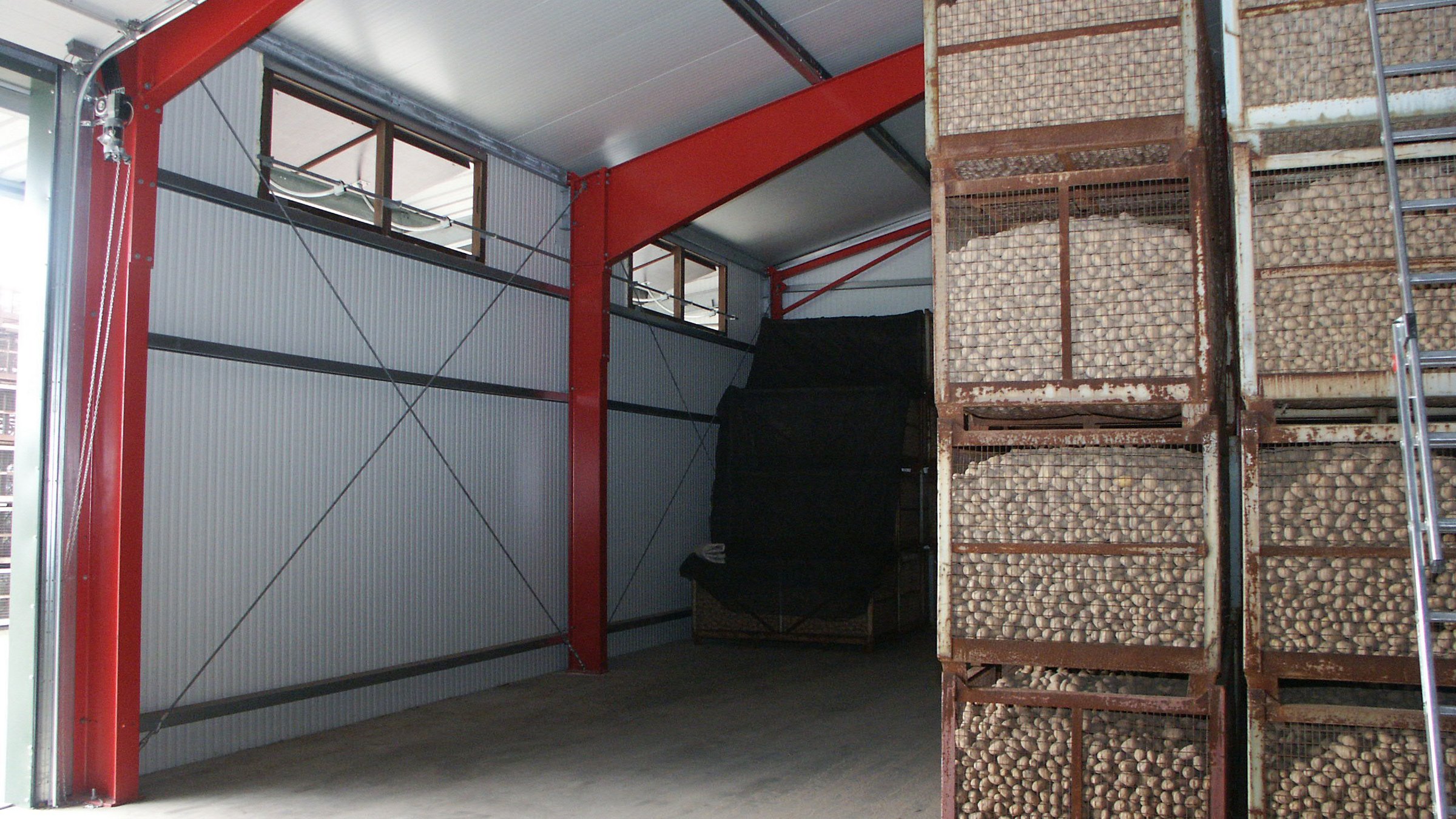
Box storage makes it possible to store even small lots separately, for example seed potatoes or table potatoes intended for direct marketing. Boxes can be filled either directly in the field using the potato harvester or on the farm with special box‑filling equipment. Box storage also facilitates unloading of different lots or small quantities. - Natural convection
In the simplest form of box ventilation—natural convection —open large boxes are placed in a storage room where air exchange occurs solely through vents, without the use of fans. Although this minimizes energy costs and noise emissions, the ability to influence storage temperature is limited due to strong dependence on weather conditions. - Room ventilation (“throw ventilation”)
In room ventilation for potatoes, the “throw ventilation” system is predominantly used. In this system, ventilation towers blow supply air at high speed across a stack of boxes. The air then flows through the stack and back to the exhaust vents next to the ventilation tower. The boxes within a row are placed close together, with a gap of around 10 to 20 cm between the rows. - Forced ventilation for closed large boxes
For forced ventilation of closed large boxes, only the single‑layer system has gained practical significance. In this system, air provided by a horizontally mounted axial fan in the ventilation wall flows through air‑outlet openings into the pallet base of each box. To ensure uniform air distribution across all boxes lined up behind each other in this single‑layer forced‑air system, the air velocity in the pallet floors should not exceed 5 m/s. - Forced ventilation for open large boxes
Forced ventilation of open large boxes can be operated either with a suction or pressure system, both of which can have very different effects on storage outcomes. For forced ventilation of open large boxes, boxes are arranged—both in suction and pressure systems—in double rows in front of a special ventilation wall, with a clear spacing of 0.4 to 0.6 meters.
While the suction system generates negative pressure in the space between the boxes of a double row, the pressure system produces positive pressure in the opposite direction.