
In the case of potatoes, the crop grows completely underground and the tubers are also very sensitive to mechanical stress due to their high water content. This makes it necessary to make batch-specific compromises during harvesting in order to harmonise quality and yield while taking into account the operational objectives.
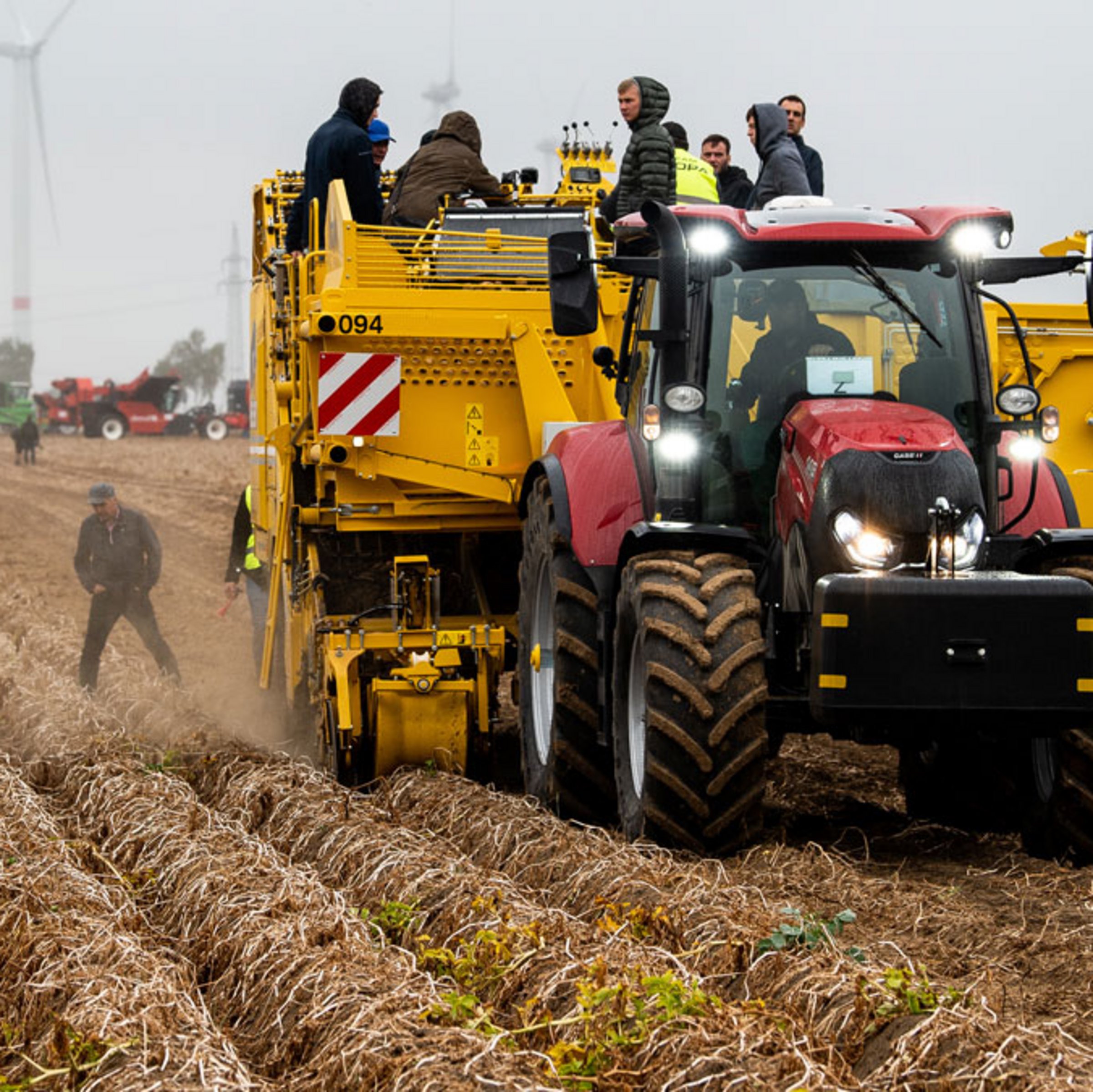
Despite the cultivation of potatoes in ridges, an average of over 1,000 m³ of soil per hectare usually has to be taken up in order to harvest the approximately 75 m³ of tubers. This very large amount of soil requires a corresponding sieve area in the harvesting machines, which is limited by the maximum width of the harvesters during road transport as well as by the machine costs. In addition, the sieving capacity of the soil varies greatly depending on the moisture content, which means that a smaller sieving surface is advisable in dry conditions and an even larger one in wet conditions.
In practical harvesting operations, this requires a high degree of adaptability on the part of man and technology in order to ensure that a closed and therefore tuber-friendly soil cushion is built up to the end of the sieving channel as far as possible. In addition to adjusting the travelling speed and speed of the sieving chains, adjustable sieving aids or changing the sieving chains can also contribute to achieving this goal. If the further transport route of the crop, e.g. by using a rear intake during storage or a transfer wagon, includes another option for separating soil and clods, the sieving intensity of the harvester can be lower than if the crop is transferred directly into large boxes at the edge of the field.
Using a haulm topper as part of the haulm reduction process significantly reduces the haulm content in the harvested crop, but very short residual stems are much more difficult to separate mechanically and usually result in increased sorting effort. The importance of separating tuber-like admixtures with the harvesting machine has declined on many farms due to the more widespread use of soil separation in spring and the concentration of cultivation on more suitable areas.
In addition, stationary roller separators are used in the storage line to separate small stones and clods in addition to loose soil. In starch potato cultivation, the focus continues to be on separating additions at harvest for cost reasons. However, the first farms are beginning to use pneumatic blending separation, which was actually designed for harvester use, as a stationary unit at the edge of the field before the potatoes are loaded onto the transport vehicles or temporarily stored in a field clamp. Thanks to the joint assembly of the receiving, cleaning and separation technology on a low-loader, this post-cleaning unit is highly mobile and is also suitable for inter-company use in line with its performance. However, the transferability of this process solution to other recycling methods is limited for quality reasons, as experience has shown that the risk of damage increases the later the hard clods and stones are removed from the material flow.
The "optimum" size of the harvester bunker is a recurring topic of discussion. While many practitioners want even larger capacities, especially for double-row, trailed harvesters, manufacturers are increasingly bound by legal requirements, e.g. for axle load or transport width and height, in order to obtain the important, EU-wide recognised type approval for their machines. Against this background, overloading bunkers that can be emptied without loss while travelling are becoming increasingly important. On the one hand, this eliminates manoeuvring times when transferring to stationary wagons, but on the other hand, with the limited bunker volume, a continuous removal chain must be ensured and transport journeys in the field with vehicles that do not always have tyres that protect the soil are increasing significantly. The first special transfer wagons, some with mechanical or pneumatic separators, are available on the market, but for cost and quality reasons they have so far only been able to prevail over traditional removal methods on a few farms.
The gentle, but also performance-orientated harvesting of potato tubers from the soil is supported by a variety of adjustment options on the harvester. On the one hand, manufacturers are taking this into account through the intensive integration of servomotors and hydraulic drives through to fully hydraulic trailed and self-propelled versions. On the other hand, more and more assemblies can be equipped with automatic control systems which, within the specified limits, independently adjust the rotational speeds to the respective operating conditions. This contributes to a significant reduction in the workload of the tractor driver, who may, however, also have to take on other tasks, e.g. due to overloading while travelling. External monitoring and control options via WLAN or Internet connections offer further quality assurance options in this context, as the driver can be supported more easily in difficult operating conditions or current assessment results can be converted directly into modified machine settings.